Beginner Low-Line Rigs (Lowest Cost)
So, you have been slacking on friends' gear for a while now and your skill is starting to develop enough that you want to have some gear of your own. You don't want to break the bank, and it looks like cruising 100-footers is going to take a bit more practice. If that is the case, then you are in luck, because you can get equipped to rig lines up to 50 feet long for a pretty minimal chunk of change.
Note that in all instances where I refer to "webbing", I am referring to 1 inch wide tubular nylon webbing that is either climb-spec or military-spec rated. Basically, this means that you need to use webbing from a reputable manufacturer that also has a minimum strength rating of 16kN or more. Second, when I refer to carabiners, I specifically mean wire-gate oval carabiners with a 23kN rating when the gate is closed. You can use other types, but I have found the wire-gate ovals to be good since it is very easy to make sure that the gates are closed.
Part of setting up these rigs safely and securely involves tying some basic knots. Instructions for these knots are linked in the list below.
- Girth Hitch (used on the ends of the line)
- Standard Slip Knot (used to boost the primitive 5:1 setup to 15:1)
- Overhand on a Bight (used when making the tree slings)
The Primitive Setup
Primitive 5:1 Multiplier
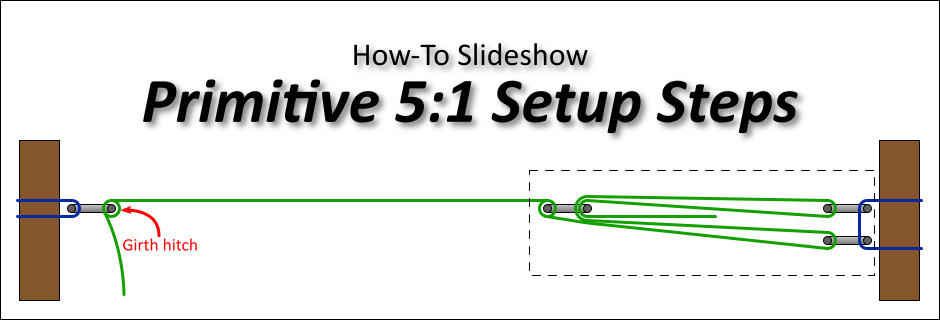
The so-called "primitive" setup is the simplest and cheapest way to put up a line (in my experience anyway). It only requires some webbing and carabiners. In its most basic form, it has a theoretical force multiplier of 5:1. This is sufficient for an average person to put up a 20ft long line on their own. Now, that theoretical multiplier of 5:1 will turn out to be more like 2.5:1 in reality because the primitive tensioning setup involves a LOT of friction between the webbing and carabiners, and the webbing with itself. As far as setup is concerned, there are a few ways to build this. Either way, the required equipment is:
- 4 x carabiners
- 2 x 20ft lengths of webbing (for trees and posts up to 2ft in diameter)
- 1 x 75ft length of webbing
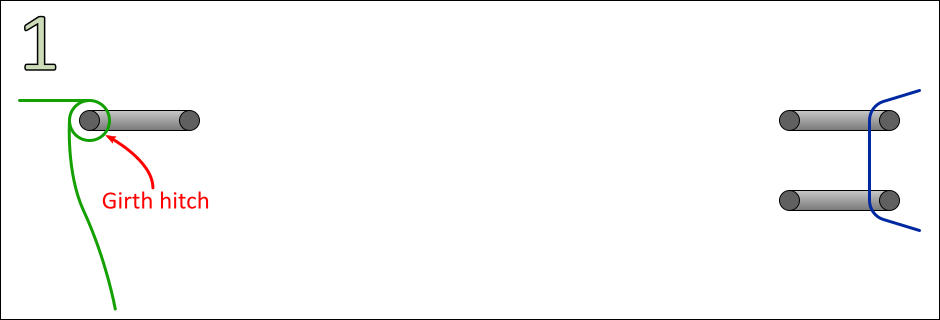
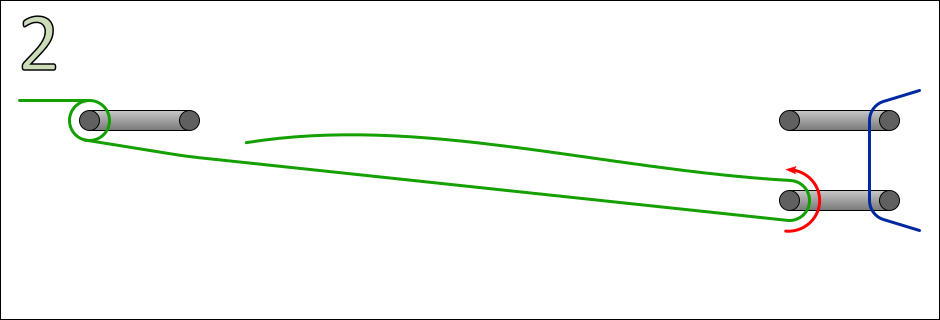
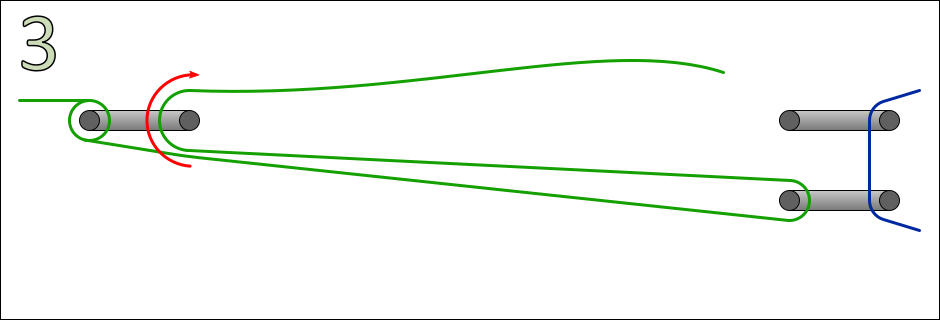
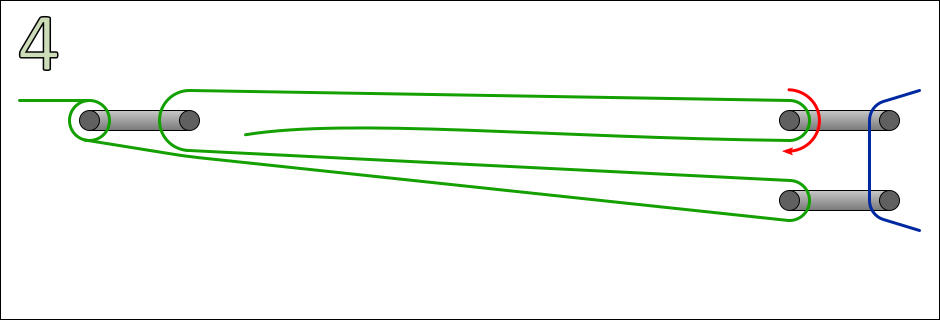
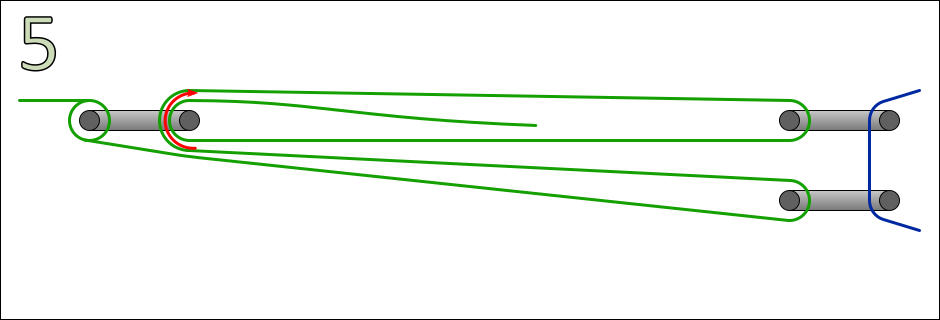
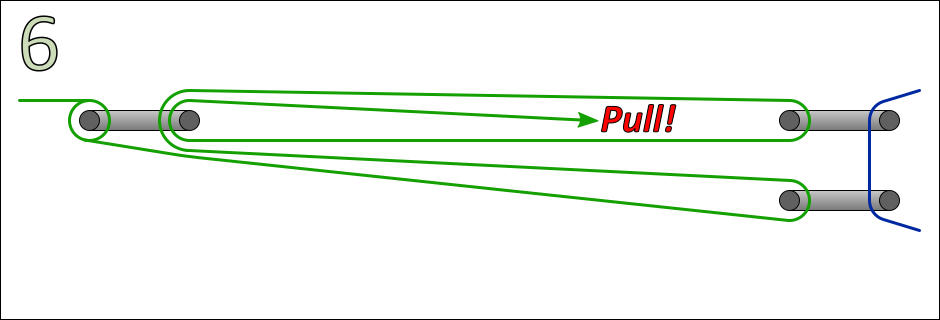
The slideshow below depicts my preferred method for short lines since it only puts one carabiner on the main part of the line where you will be walking (I like to keep the main line as light as possible). The drawback is that it can be a little awkward to have two carabiners in the sling moving around against oneanother, but it has proven to be pretty easy to manage as long as you keep an eye on the gates to make sure that they remain fully closed. When you are all done, it is super easy to take the rig down. You just pull the loose end of the webbing (on the tensioning side) out from under the overlap loop that holds it all in place.
Primitive 15:1 Multiplier
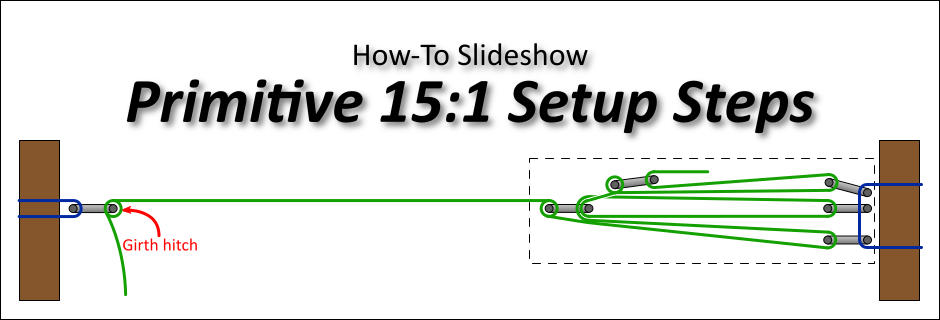
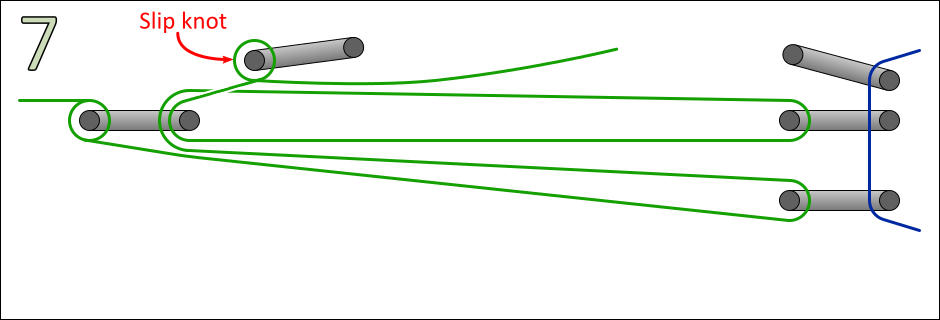
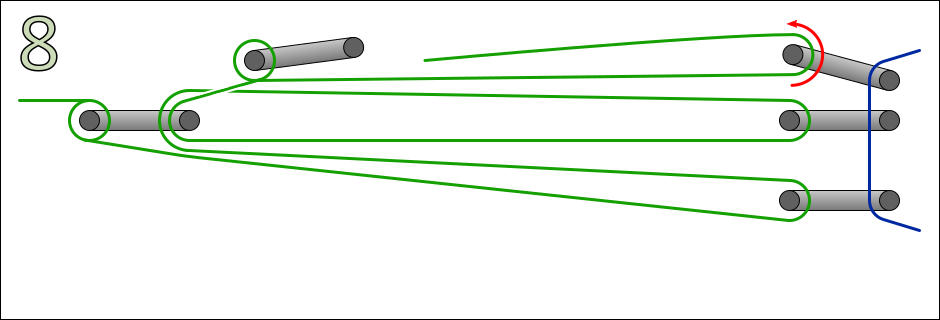
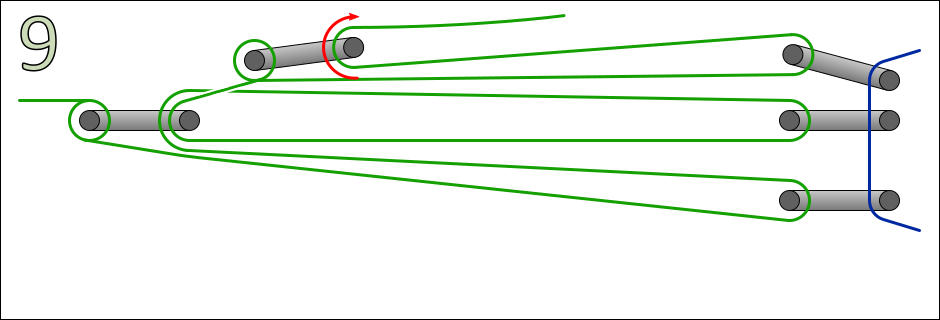
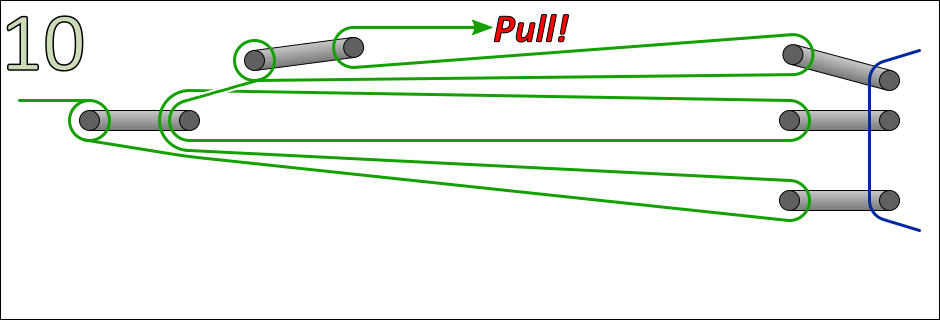
If you are setting up a rig on your own, or are pushing the limits of the primitive tensioning system with a 50ft long line, you will need a bigger multiplier to put tension in the line. The 5:1 system is good for 20ft lines with a single person doing setup, and 30ft with two people. Thankfully, you can increase the 5:1 system to a 15:1 system by simply adding 2 more carabiners. This makes 30ft lines easy to rig with one person, and you can get up to 50ft long with two reasonably strong people. In order to set this up, and I recommend buying enough carabiners for this in the first place, take a look at the list below.
- 6 x carabiners
- 2 x 20ft lengths of webbing (for trees and posts up to 2ft in diameter)
- 1 x 75ft length of webbing
The complete list of steps is given in the slideshow below. The first 6 should steps look pretty familiar!
Final Thoughts
I still use these primitive rigs pretty regularly when I am setting up lines 30ft long or less. Although I do own a Slackline Brothers pulley system, which is fantastic for setting up longer lines, I prefer the primitive setup for lines of 30ft length or less. It is fast to set up and adjust for a new line, and it puts much less mass in the line than the pulleys which makes for a more fluid experience on short lines. The 15:1 primitive setup can be used to rig lines up to 50ft long in my experience, but it requires at least two people and it does put a fair amount of wear on the gear. You could always add another 3:1 multiplier on (which would take another 2 carabiners) to get a 45:1 multiplier, but at that point you are probably ready to bump yourself up to a dedicated tensioning setup with higher efficiency and less wear on your gear!